
Konterbass
An electroacoustic string instrument built to experience music-making as negotiation between player and object
Playing on the Konterbass can feel a little intimidating. Half acoustic, half electronic instrument, it can respond to your play with its own flavour of sound and rhythm. Almost as if it had a will of its own.
The name “Konterbass” is a wordplay on Kontrabass, German for double bass and kontern, German for countering, which refers to the instrument seemingly countering and responding to the player.
I worked on this project during my exchange semester at Burg Giebichenstein University of Art and Design as part of the course “Unerhörte Töne” (unheard-of sounds) taught by professor Guido Englich. The technical setup is based on the Halldorophone, an experimental string instrument by Icelandic artist and designer Halldór Úlfarsson.

The illusion of will
My idea behind this project was to create an instrument that exhibits its own “behaviour”, that can be recognised as an actor rather than object, one that lets the player experience music-making not as instrumentalisation but as negotiation with the instrument.
What allows the Konterbass to seemingly show behaviour is an acoustic feedback loop, known mostly as unpleasant screeching when a microphone is held too close to a loudspeaker. Through this effect the Konterbass constantly amplifies its own string vibrations, which start to oscillate through inputs as subtle as ambient noise or a person walking past the instrument. Even when not being played, the Konterbass will slowly begin to amplify some inaudible vibration and produce its characteristic drone sound.
Combined with player input such as string plucking or drumming on the resonance body, the Konterbass unpredictably reacts to a variety of vibrations. You can expect it to respond to your play with its own flavour of sound and rhythm. Take this response as inspiration, and you will quickly find yourself in something like a human-instrument jam session.


Objects as actors
From a conceptual point of view I was inspired by the Actor-Network Theory (ANT) developed by Madeleine Akrich, Michel Callon and Bruno Latour. A social-philosophical theory, ANT views the world as a collection of actors connected through always-shifting relationships. Crucially, an actor is not necessarily human — objects, ideas and processes are also treated as actors.
With the Konterbass, I attempted create an instrument which makes Actor-Network Theory experienceable to a player, an instrument that shows you, makes you feel that it too has power, an instrument that you will play with, not on.


Technical setup
The following components are used:
- 2x piano-wire strings
- 2x electromagnetic pickups (similar to those on e-guitars)
- 1x Teensy 3.2 microcontroller
- 1x Teensy 3.x audio shield
- 1x 12V amplifier
- 1x small potentiometer regulating global volume
- 2x potentiometer controlling the pickups’ sensitivity
- 1x DAEX32EP-4 surface transducer
- 1x battery board + battery (powering the Teensy)
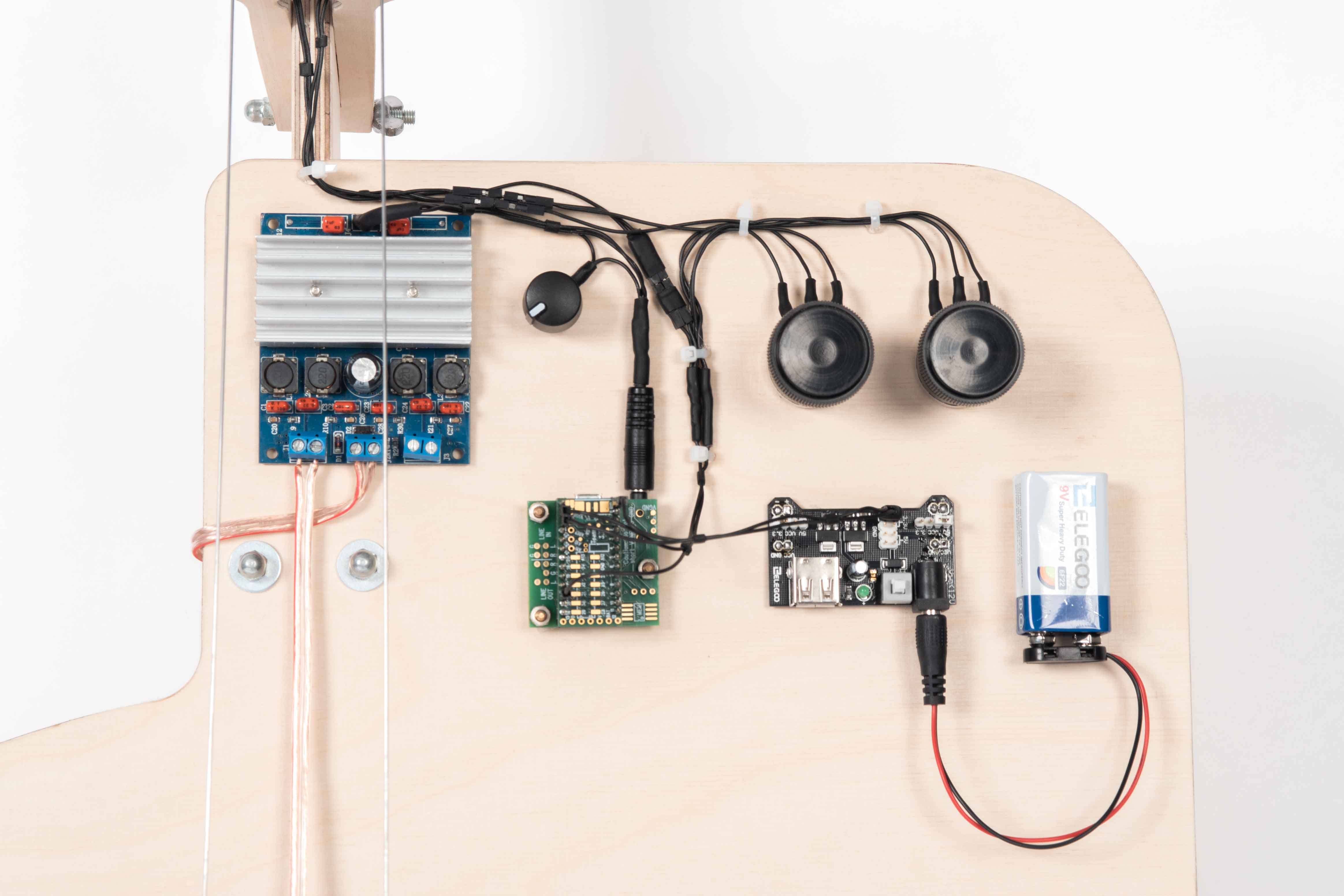
The pickups function as microphones picking up the string vibrations as oscillating signals, which are sent to and processed by the Teensy microcontroller. Audio effects such as delay or flange can be added via code. From there the teensy sends the signals via the potentiometers to the amplifier, which then feeds the amplified signal into the surface transducer. The transducer, basically a speaker without speaker cone, plays the signal as sound back into the resonance chamber. Via the bridge the vibrations caused by the sound then reach the strings again. This closes the loop.


Since the pickups’ signals are amplified by the amplifier and fed back to the pickups’ by the speaker, the whole system is constantly locked into a positive gain loop. This creates its erratic, unpredictable sound and causes it to start producing sound from even small vibrations such as steps, clapping or talking.
For more details on the construction and programming of the Konterbass reach me via mail :)